Since 1965
Push Ningjiang Machine Tool Co., Ltd.
  • 
  • Home
  • Products +
  • Applications
  • About Us +
    • Company Profile
    • R&D and Design
    • Manufacturing
    • Quality Control
    • History
  • Service
  • Contact
  • Videos
5-Axis Machining Centers
  • Home
  • Products
  • CNC Machining Centers
  • 5-Axis Machining Centers

5-Axis Machining Centers

Five-axis machining centers with worktables ranging from ø500 to ø2000 mm are offered in four configurations: models with a cradle rotary table, versions with a 45° tilt head for vertical–horizontal switching, designs with a fork milling head, and high-speed dual-spindle setups. Each configuration offers enough rigidity and positioning stability for continuous five-axis movement. This makes it easier to finish complex surfaces and several faces of a part without changing the setup. The same capabilities are used across aerospace components, nuclear-energy parts, automotive and motorcycle pieces, and mold and tooling work that requires consistent accuracy and controlled changes in orientation.
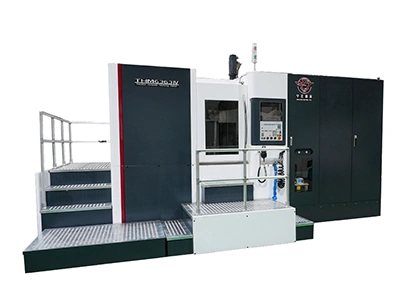
5-Axis Machining Center (with Cradle Rotary Table)

The cradle-type five-axis machining centers use a T-shaped monolithic bed to support the tilting rotary table, with worktable sizes ranging from 650 to 1200 mm.
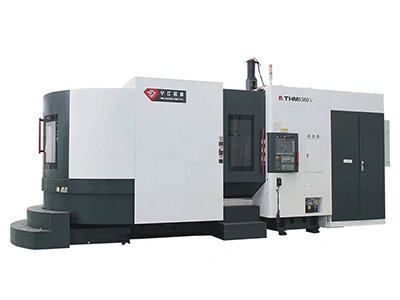
5-Axis Machining Center (with 45° Tilt Head)

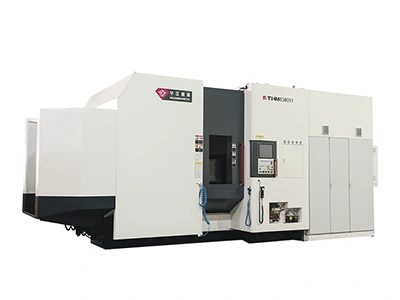
The 5-axis machining centers with a 45° tilt head use a T-shaped layout, with the column moving on the X axis, the spindle head travelling vertically on the Y axis, and the table advancing along the Z axis.
5-Axis Machining Center (with Fork Milling Head)

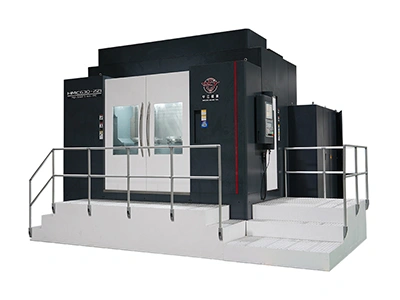
5-axis machining centers with a fork-type milling head use a T-shaped structure: the column moves on the X axis, the spindle head travels vertically on the Y axis and the table advances along the Z axis.
5-Axis Machining Center (with Dual Spindle)

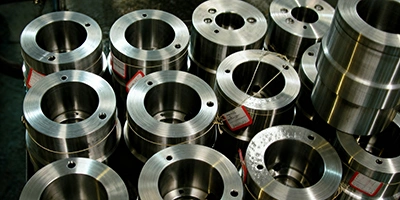
They are widely used for aluminum-alloy components in new-energy vehicles and aerospace production, since the dual-spindle and dual-rotary-table arrangement helps keep the surface finish cleaner, the dimensions more stable, and the machining time shorter.
CNC Machines
  • CNC Machining Centers
    1. Horizontal Machining Centers
    2. 5-Axis Machining Centers
  • CNC Gear Cutting Machines
  • CNC Lathes
  • CNC Jig Grinding & Boring Machines
Applications
  • Aerospace Complex Parts Machining Aerospace Complex Parts Machining
  • Marine Diesel Engine Cylinder Head Machining Marine Diesel Engine Cylinder Head Machining
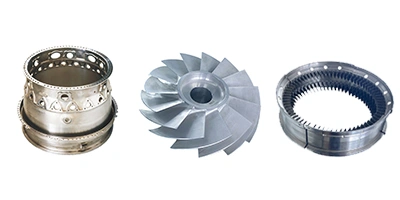
  • Aircraft Engine Parts Machining Aircraft Engine Parts Machining
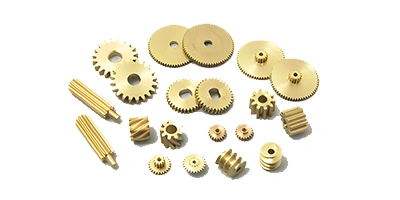
  • Automotive Gear Machining Automotive Gear Machining
  • Fishing Reel Parts Machining Fishing Reel Parts Machining
  • Test Probe Machining Test Probe Machining
Need Support Selecting the Right CNC Machine?

Contact us for technical details, quotations or application-specific solutions. Our team will respond shortly.

Contact Us Today!
Applications & Solutions
Aerospace Complex Parts Machining
CNC Machines for Aerospace Complex Parts Machining
Marine Diesel Engine Cylinder Head Machining
CNC Machines for Marine Diesel Engine Cylinder Head Machining
Aircraft Engine Parts Machining
CNC Machining Solutions for the Aerospace Industry
Automotive Gear Machining
CNC Machines for Automotive Gear Machining
Learn More
Why Us
R&D and Design
R&D and Design
Manufacturing
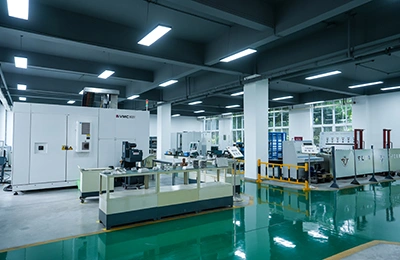
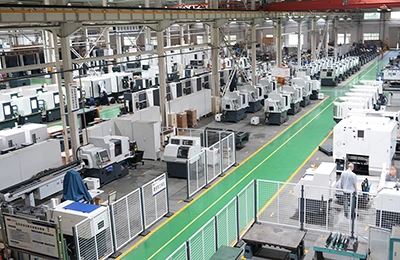
Manufacturing
Quality Control
Quality Control
Service & Support
Service & Support
Some of Our Customers
  • Customers
  • Customers
  • Customers
  • Customers
  • Customers
  • Customers
  • Customers
  • Customers
  • Customers
  • Customers
  • Customers
  • Customers
  • Customers
  • Customers

Can a five-axis horizontal machining center maintain micron-level accuracy?

The machining accuracy reaches the micron range, with typical positioning accuracy around 8 μm and repeatability around 4 μm.

What type of workpieces benefit from five-axis horizontal machining?

Five-axis horizontal machining centers are used for parts that require several orientation changes or complex curved surfaces, such as aerospace components, turbine parts, precision housings, structural frames and mold geometries that must be completed in fewer setups.

How does five-axis horizontal machining improve process stability?

The horizontal setup makes chip removal easier during long cuts, so the cutting area stays more stable. Because the five axes let the part be reached from different angles, it doesn’t need to be moved as many times. With fewer moves, the size changes less and the accuracy stays steadier.

Products
  • CNC Machining Centers
  • CNC Gear Cutting Machines
  • CNC Lathes
  • CNC Jig Grinding & Boring Machines
Applications & Solutions
  • Aerospace Complex Parts Machining
  • Marine Diesel Engine Cylinder Head Machining
  • Aircraft Engine Parts Machining
  • Automotive Gear Machining
  • Fishing Reel Parts Machining
  • Test Probe Machining
Quick Links
  • Company Profile
  • R&D and Design
  • Manufacturing
  • Quality Control
  • Service & Support
  • History
  • Videos
Contact Us
export@ningjiang.com
+8618982091443
www.linkedin.com/in/文韬-寇-953778276
PUSHNINGJIANG
k1029358101
+86-28-87229738